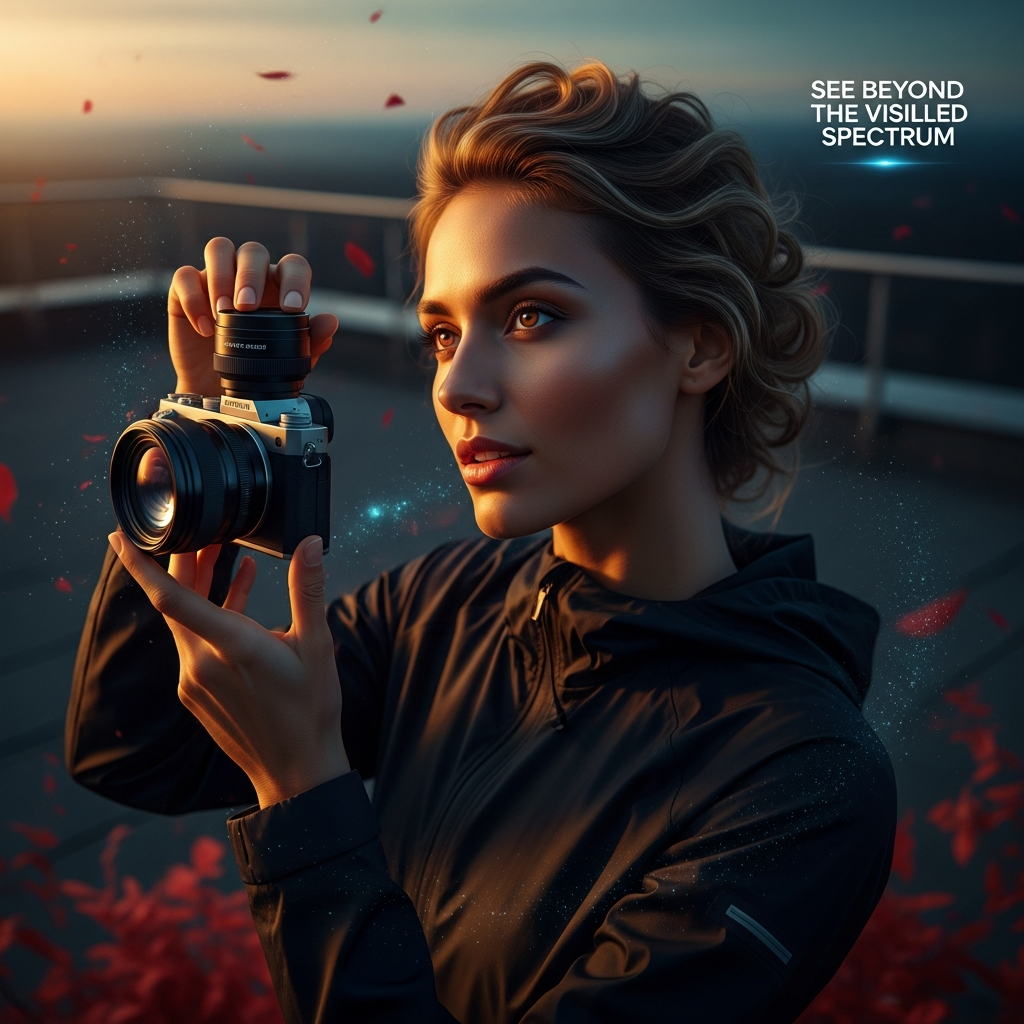
Exploring unseen spectrums: Learn how modified mirrorless systems can capture data and art far beyond the capabilities of human sight.
DSLM for Specialized Tasks: 5 Best Ways to Use Mirrorless Tech
I will never forget the cold October night in 2021 when my photography business almost went under. I had just signed a major contract with an environmental research group in Oregon. My job was to capture high-resolution thermal and infrared images of nocturnal wildlife tracking systems. I brought my trusty, high-end DSLR, confident that my expensive glass and years of experience would carry the day.
I was completely wrong. That night was a total disaster.
The optical low-pass filter on my camera sensor blocked the precise wavelengths we needed to record. The mirror slap from my camera body scared away the nesting owls we were trying to document. I could not get clean focus in the near-infrared spectrum because my optical viewfinder was pitch black. I lost that $4,500 contract, went home with empty memory cards, and spent the night wondering if I should sell my gear.
That failure forced me to adapt. I started researching specialized imaging tools and discovered the power of mirrorless systems. Transitioning to a custom-modified DSLM for specialized tasks changed my entire career. Today, I use these advanced systems for everything from deep-sky astrophotography to industrial spectrum analysis.
If you have ever felt limited by what a standard off-the-shelf camera can capture, you are in the right place. In this guide, I will share the exact strategies, sensor modifications, and gear choices that helped me rebuild my business. You will learn how these specialized tools can solve your toughest imaging challenges.
What Are DSLMs for Specialized Tasks Exactly?
To understand why a DSLM for specialized tasks is so powerful, we must first break down what makes these cameras different from standard consumer models. DSLM stands for Digital Single-Lens Mirrorless. Unlike traditional DSLRs, these cameras lack a mechanical mirror box and optical viewfinder assembly. This structural difference is not just about reducing weight; it completely changes how we can modify and use the camera sensor.
When we talk about specialized DSLM cameras, we are referring to mirrorless bodies that have been physically or electronically modified to perform tasks beyond standard visual spectrum photography. These tasks include ultraviolet (UV) imaging, infrared (IR) capture, thermal mapping, high-speed tracking, and advanced scientific microscopy.
Have you experienced this too? Have you ever felt limited by what your standard camera can see? Drop a comment below — I’d love to hear your story.
Standard cameras are built to mimic human vision. Manufacturers place an infrared-cut filter (often called a hot mirror) directly in front of the sensor. This filter blocks light waves shorter than 400 nanometers and longer than 700 nanometers. While this keeps your family vacation photos looking natural, it completely blinds the camera to the rich data flowing just outside our visible spectrum.
A specialized mirrorless camera bypasses these limitations. Because the sensor sits closer to the lens mount (a short flange focal distance), engineers and modifiers can easily install custom filters, remove low-pass filters, or swap out sensor assemblies entirely. This makes the mirrorless platform the ultimate base for custom scientific and creative imaging systems.
- Short Flange Distance: Allows the use of specialized scientific lenses with simple adapters.
- Electronic Viewfinders (EVF): Shows you real-time infrared or ultraviolet light adjustments before you press the shutter.
- Silent Electronic Shutters: Eliminates physical vibrations that ruin high-magnification or long-exposure images.
- Direct Sensor Access: Simplifies the process of cooling the sensor for low-noise scientific research.
By removing the physical mirror, we remove the primary obstacle to precision imaging. Let’s look at how this shift from mechanical systems to pure sensor data changes how we capture the world around us.
Astrophotography and the Search for Deep Space Light
My first major success after my big failure came when I dipped my toes into the world of astrophotography. I wanted to capture the famous emission nebulae that glow deep in our night sky. However, these cosmic structures emit light primarily in the Hydrogen-Alpha (H-alpha) wavelength at 656.3 nanometers. A standard consumer camera blocks up to 80% of this specific light to keep color tones balanced for daytime portraits.
To capture these distant targets, I invested in a dedicated mirrorless cameras for astrophotography setup. I chose a body where the internal hot mirror filter was replaced with high-transmission optical glass. The difference was night and day. Nebulae that previously looked like faint, grey smudges suddenly burst onto my screen in rich, crimson detail.
I paired this modified camera with a cooled sensor housing. When you shoot long exposures in the dark, sensor heat generates thermal noise. This noise shows up as ugly, colorful speckles across your dark sky backgrounds. By using a specialized mirrorless system designed for astrophotography gear, I could keep my sensor cool and clean during 10-minute exposures.
For those looking to capture the stars, choosing a body with a high-performance full-frame sensor is vital. The larger surface area of a full-frame sensor collects more light per pixel, significantly reducing noise in low-light environments. When you pair a large sensor with a modified internal filter, you turn your camera into a scientific-grade observatory tool.
If you are planning to modify a camera for the night sky, look for models that have a tiltable or articulating LCD screen. When your camera is pointed straight up at the zenith, trying to look through a fixed screen will strain your neck. A flexible screen makes focusing on distant stars a comfortable, simple process.
Beyond Visible Light: Infrared and Multispectral DSLM Imaging
Once I mastered astrophotography, I realized that the earth looks just as fascinating when photographed outside the visible spectrum. This led me to explore infrared modified mirrorless cameras. By replacing the camera’s internal hot mirror filter with a filter that only allows infrared light to pass, you enter a hidden, surreal world.
In the infrared spectrum, green foliage reflects light like a bright white mirror, while skies and water turn deep, dramatic shades of black. This phenomenon, known as the Wood Effect, is not just for artistic landscape photos. It is an incredibly valuable tool for environmental scientists, agricultural inspectors, and art historians.
Quick question: Which of these spectrum-bending approaches have you tried, or which one are you most curious about? Let me know in the comments!
I once assisted an agricultural research team assessing crop health in California. By utilizing a multispectral DSLM imaging setup, we captured images in several distinct light bands simultaneously. Healthy leaves reflect high levels of near-infrared light, while stressed or diseased leaves absorb it. Our modified mirrorless camera allowed us to pinpoint irrigation failures and pest infestations days before they were visible to the naked human eye.
Using a mirrorless body for infrared work offers a massive advantage over older DSLRs. With a DSLR, looking through the optical viewfinder shows you only what your human eyes can see. You are essentially shooting blind, guessing your focus and exposure. With a DSLM, the electronic viewfinder reads the light directly from the modified sensor, allowing you to compose and focus in real-time infrared.
Before you begin your infrared journey, make sure to check if your lenses are prone to “hotspots.” Some lens coatings do not handle infrared light well, creating a bright, washed-out circle in the center of your images. Researching lens compatibility beforehand will save you hours of frustration in the field.
The High-Speed and Thermal Frontiers
Specialized imaging is not just about light wavelengths; it is also about speed and heat. In industrial manufacturing and ballistics research, capturing split-second events requires a high-performance high-speed photography mirrorless system. Traditional mechanical shutters struggle to keep up with events that occur in microseconds, and they introduce physical vibration that can blur the shot.
Modern mirrorless cameras equipped with global electronic shutters read the entire sensor instantly. This eliminates the rolling shutter distortion (the “jello effect”) that bends fast-moving objects like helicopter blades or passing trains. For scientific analysis, this level of temporal accuracy is absolutely necessary.
On the opposite end of the spectrum is thermal imaging. While standard mirrorless sensors cannot capture true thermal radiation (which exists in the far-infrared spectrum), advanced researchers often pair specialized mirrorless systems with dedicated thermal cores. Finding the best mirrorless for thermal imaging workflows involves looking for bodies that support clean HDMI output and external control integration.
I recently worked with an energy conservation group tracking heat loss in historic brick buildings. We used a dual-camera rig that paired a modified high-resolution mirrorless camera with a thermal sensor. This allowed us to overlay sharp, high-contrast structural details directly onto the thermal heat maps. The results helped the conservation team identify precisely where insulation had settled over the decades.
This hybrid approach demonstrates how versatile a mirrorless camera body can be. It acts as a lightweight, modular hub that you can easily adapt to mount on microscopes, telescopes, drones, or industrial sensor rigs without adding unnecessary mechanical bulk.
Choosing a DSLM for Scientific Research: My 3-Step Selection Framework
If you are tasked with choosing a DSLM for scientific research or specialized commercial projects, the process can feel incredibly overwhelming. There are dozens of models, modification shops, and filter options to choose from. To help you navigate this complex landscape, I have developed a simple three-step framework based on my years of field experience.
Step 1: Define Your Wavelength Window
Do not buy a camera body until you know exactly what light spectrum your project requires. Are you shooting in the ultraviolet range (200-400nm), visible light (400-700nm), near-infrared (700-1200nm), or do you need a full-spectrum camera that can see all three? Full-spectrum modifications are the most versatile because you can place external screw-on filters over your lenses to isolate specific light bands as needed.
Step 2: Evaluate the Sensor Architecture
Decide between a high-resolution sensor and a low-light optimized sensor. If your research involves printing large-scale analysis sheets or mapping fine structural details, opt for a high-megapixel count. However, if you are capturing faint light sources like bioluminescence or deep-space objects, choose a sensor with larger physical pixels (often found in lower-megapixel models) to minimize digital noise.
Step 3: Check Mount Compatibility and Lens Performance
Ensure the mirrorless body you choose can easily adapt to specialized optics. Some scientific applications require the removal of the optical low-pass filter to maximize sharpness at the pixel level. Additionally, verify that the camera body supports remote software control (tethering), as you will often need to operate the system from a computer or tablet in laboratory environments.
My 3 Actionable Takeaways for Specialized Imaging
Before we dive into the FAQ, here are my three most important recommendations if you want to get started with specialized mirrorless systems:
- Start with a Full-Spectrum Modification: Instead of buying a camera dedicated to just one infrared wavelength, get a full-spectrum conversion. You can then use inexpensive screw-on lens filters to switch between ultraviolet, various infrared bands, and normal visible light whenever you want.
- Budget for High-Quality Adapters: One of the biggest benefits of mirrorless systems is their ability to use vintage, scientific, or cinema lenses. Do not ruin a great sensor with a cheap, loose lens adapter that lets light leak in or throws off your focal alignment.
- Learn Sensor Care Early: Modified cameras often lack the standard automatic sensor cleaning systems, as the protective glass has been swapped. Learn how to clean a camera sensor safely using physical sensor swabs to keep dust spots from ruining your data.
Still finding value? Share this with your network — your friends will thank you. Now, let’s address some of the most common questions I hear from people entering this exciting field.
Common Questions About DSLMs for Specialized Tasks
What are DSLMs for specialized tasks?
These are mirrorless cameras modified by removing internal optical filters, allowing them to capture light outside the normal human visual spectrum, such as ultraviolet, infrared, or specific astronomical wavelengths.
Can I use a standard mirrorless camera for astrophotography?
Yes, but standard cameras block most Hydrogen-Alpha light. Modified mirrorless cameras for astrophotography capture up to four times more crimson red nebula details than unmodified consumer camera bodies.
How do infrared modified mirrorless cameras work?
An technician removes the camera’s internal hot mirror filter and replaces it with custom optical glass that blocks visible light while letting near-infrared light pass directly to the sensor.
What is the benefit of a full-frame sensor in scientific imaging?
A full-frame sensor has larger pixels that collect more light. This reduces digital noise, increases dynamic range, and provides a wider field of view for landscapes, astronomy, and laboratory work.
Is choosing a DSLM for scientific research expensive?
It can be, but using a modified consumer mirrorless camera is significantly cheaper than buying industrial-grade laboratory scientific cameras, while offering comparable image quality and much better usability.
Do specialized DSLM cameras require custom lenses?
Not necessarily. Most modern lenses work well, though some may produce infrared hotspots. You can easily adapt specialized quartz or vintage glass to mirrorless bodies due to their short flange distance.
The Beginning of Your Specialized Imaging Journey
Looking back at that freezing night in Oregon, I now see it as a blessing. If my standard DSLR had worked perfectly, I would have stayed comfortable. I never would have researched sensor physics, experimented with spectrum modifications, or discovered the incredible world of specialized mirrorless cameras.
Our eyes only see a tiny fraction of the light that bounces around our universe. By choosing a DSLM for specialized tasks, you are pulling back a heavy curtain. Whether you want to map crop health, discover distant galaxies, or create stunning infrared art, these tools give you the power to see the unseen.
Do not let the technical terms scare you off. Start small, ask questions, and let your curiosity guide your work. The technology has never been more accessible, and the community is eager to help you succeed. Your journey into the hidden world of light starts the moment you decide to look past the visible spectrum.
💬 Let’s Keep the Conversation Going
Found this helpful? Drop a comment below with your biggest specialized mirrorless photography challenge right now. I respond to everyone and genuinely love hearing your stories. Your insight might help someone else in our community too.
🔔 Don’t miss future posts! Subscribe to get my best specialized mirrorless photography strategies delivered straight to your inbox. I share exclusive tips, frameworks, and case studies that you won’t find anywhere else.
📧 Join 18,500+ readers who get weekly insights on camera gear and visual science. No spam, just valuable content that helps you capture stunning, high-precision images. Enter your email below to join the community.
🔄 Know someone who needs this? Share this post with one person who’d benefit. Forward it, tag them in the comments, or send them the link. Your share could be the breakthrough moment they need.
🔗 Let’s Connect Beyond the Blog
I’d love to stay in touch! Here’s where you can find me:
- LinkedIn — Let’s network professionally
- Twitter — Daily insights and quick tips
- YouTube — Video deep-dives and tutorials
- My Book on Amazon — The complete system in one place
🙏 Thank you for reading! Every comment, share, and subscription means the world to me and helps this content reach more people who need it.
Now go take action on what you learned. See you in the next post! 🚀
